Scam alerts
See all scam alerts, each on its own page →
Short, plain-language write-ups of scams that officials and local news have recently warned about in North Carolina and the Triad. Newest first.
Posted November 3, 2026
Calls from a "deputy" about missed jury duty, with a Bitcoin ATM payment
Callers are pretending to be sheriff's deputies or "Court Services" staff in the Triad. They say you missed jury duty or have a warrant, and that you can pay a fine now to clear it, usually by putting cash into a Bitcoin ATM. The Forsyth County and Guilford County Sheriff's Offices say they will never call and demand money this way.
How it works: The caller may use a real officer's name, and caller ID can be faked to show a real local number. The Guilford County Sheriff's Office says scammers have made calls look like they come from the real Court Services line. The caller keeps you on the phone, tells you not to tell anyone, has you withdraw cash, and texts a QR code to scan at a Bitcoin ATM at a gas station or store.
Red flags:
- A call about missed jury duty or a warrant that you can "pay off" right now
- Payment by Bitcoin ATM, gift cards, wire transfer, or cash
- Being told to stay on the line or keep it secret from family or your bank
What to do: Hang up. Look up the Sheriff's Office number yourself instead of calling back: Forsyth County non-emergency 336-727-2112, Guilford County 336-373-2222. Talk it over with someone you trust before taking out any money. If you already paid, keep the receipt and report it at ic3.gov and to the Sheriff's Office. People 60 and older can call the National Elder Fraud Hotline at 833-372-8311 for help.
Sources: WXII, Guilford County Sheriff's Office · WFMY News 2 · Forsyth County Sheriff's Office · FBI IC3
Read the full guide: Is that call from a "deputy" about missed jury duty or a warrant a scam? →
This alert summarizes the news reports and official warnings linked above. It's general information, not legal or financial advice.
Posted November 2, 2026
Before the holidays: "grandkid in trouble" calls that use AI to copy a loved one's voice
As families start traveling for the holidays, scammers call grandparents pretending to be a grandchild in a crisis: an arrest, a car accident, or bail money. What's new is that the voice on the line can sound exactly like your grandchild. The NC Department of Justice warns that scammers can use artificial intelligence (AI) to copy a loved one's voice, and the Consumer Financial Protection Bureau says these scams are especially common around the holidays.
1. AI voice-clone "family emergency" calls
How it works: Scammers look up your family on the internet and social media, so they know names and details that make the call sound real. Then a caller who sounds like your grandchild says they're in trouble, begs you not to tell their parents, and asks you to wire money or buy gift cards right away. Sometimes a second person gets on the line pretending to be a lawyer or officer. The FBI's top agent in North Carolina told CBS 17 his office is seeing scams that copy a person's voice, video, or both to trick family members into wiring money.
Red flags:
- An urgent call asking for money, especially by wire transfer, gift cards, or cryptocurrency
- The caller asks you to keep it secret or says there's no time to check
- The voice sounds right, but the story can't be confirmed with anyone else in the family
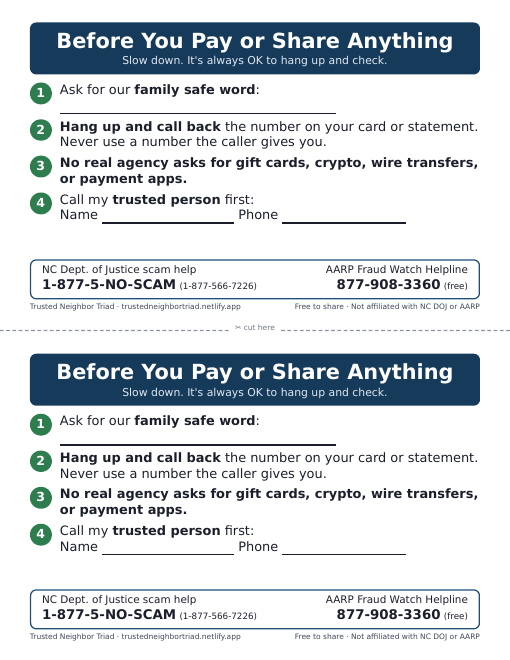
What to do: Hang up. Don't press redial. Call your grandchild, or their parents, at a number you already have. On a landline, the NC Department of Justice suggests waiting a few seconds before picking up again so the scammer is really disconnected. Ask a question only your real family member could answer, and consider agreeing on a family code word ahead of time. If someone asks you to pay with gift cards, it's a scam.
Sources: NC Department of Justice AI scam alert · NC DOJ Senior Scam Guide · Consumer Financial Protection Bureau · CBS 17
Read the full guide: Is that "grandchild in trouble" call a scam? →
2. Fake videos of famous people promising "guaranteed" returns
How it works: In October the Watauga County Sheriff's Office listed investment and cryptocurrency scams among its top 10 local scams, warning that they use AI-generated videos of recognizable public figures to promise guaranteed returns. The video looks and sounds real, but the person never said it.
What to do: Treat any online ad or video promising guaranteed returns as a scam, no matter who appears in it. Never send money or crypto to a platform you found through an ad or a stranger's message. Talk to someone you trust, or your own bank, first.
Sources: WataugaOnline, Oct. 2, 2026
Protect your family's voices
- Check privacy settings so strangers can't see your family's posts.
- The NC Department of Justice suggests reviewing and removing audio recordings of yourself and loved ones from social media.
If you already sent money
It happens to careful, loving people. Call your bank or the company you sent money through right away. Report it to the FBI at tips.fbi.gov or 1-800-CALL-FBI, and to the NC Department of Justice at 1-877-5-NO-SCAM or ncdoj.gov/complaint.
If something doesn't feel right
Take your time, and talk it over with someone you trust. There's no shame in it, and reporting helps your neighbors too.
This alert summarizes the news reports and official warnings linked above. It's general information, not legal or financial advice.
Posted October 29, 2026
Holiday shipping season: fake "missed delivery" texts and unpaid toll texts
With holiday shopping starting, many of us are expecting packages. Scammers know that, and they send texts that look like they come from the Post Office, UPS, FedEx, or a toll agency like NC Quick Pass. The good news: both kinds of text are easy to check on your own, without using anything in the message.
1. Fake package delivery texts (USPS, UPS, FedEx)
How it works: You get a text saying a package couldn't be delivered because of a problem with your address, unpaid postage, or a missed delivery. It includes a link to "reschedule" or pay a small "redelivery fee." The link goes to a look-alike website that collects your card number and personal information. AARP reports that, according to the Federal Trade Commission, package delivery messages were the most-reported kind of text scam. One caller to AARP's helpline paid a 99-cent fee and was later charged $400.
Red flags:
- A text from the Post Office when you never signed up for tracking on that package. The U.S. Postal Inspection Service says USPS doesn't text you unless you asked for updates with a tracking number, and its texts won't contain a link.
- A request for a fee, your card number, or personal information to release a package
- No tracking number, or a web address that's close to the real one but not quite (for example, "fedx" instead of "fedex")
What to do: Don't tap the link or reply. If you're expecting something, look it up on the store's website where you ordered it, or type usps.com, ups.com, or fedex.com into your browser yourself. A paper "missed delivery" note on your door works the same way: look up the carrier's number on its official website instead of calling the number on the note.
Sources: AARP, updated Oct. 28, 2026 · U.S. Postal Inspection Service · USPIS holiday tips · FCC
Read the full guide: Is that USPS "missed delivery" text a scam? →
2. "Unpaid toll" texts, including fake NC Quick Pass messages
How it works: A text says you owe a small unpaid toll and will be charged a late fee, or lose your license or registration, if you don't pay through a link. North Carolina's Attorney General and the NC Turnpike Authority say these texts are sent at random, so you can get one even if you've never driven on a toll road. WXII reported in March that the NC Department of Justice was warning about a newer version claiming an unpaid parking or toll violation.
How to tell the real NC Quick Pass from a fake:
- NC Quick Pass only sends texts from the short number 696277.
- NC Quick Pass never asks for payment by text.
- Real NC Quick Pass links contain ncquickpass.com.
- NC Quick Pass won't threaten legal action over an unpaid toll, and you won't lose your license for one, according to the state.
What to do: Don't tap the link or reply, not even "STOP" or "Y." To check whether you really owe anything, type ncquickpass.com into your browser yourself, or call NC Quick Pass at 877-769-7277. If the text names a toll agency in another state, look up that agency's number on its own website. Then delete the text.
Sources: NC Department of Justice & NC Turnpike Authority · NC Quick Pass scam alert, May 2026 · WXII, March 25, 2026 · FBI IC3 public service announcement
Read the full guide: Is that unpaid NC toll text a scam? →
Where to report these texts
- Forward the text to 7726 (spells "SPAM"). This helps your phone company block similar messages. Many phones also have a "Report junk" button.
- Fake Post Office texts: email a screenshot to spam@uspis.gov.
- Fake UPS or FedEx texts: forward them to fraud@ups.com or abuse@fedex.com.
- Any of these scams: report it to the FTC at ReportFraud.ftc.gov or the FBI at ic3.gov.
If you already clicked or paid
It happens to careful people every day. Call the number on the back of your bank or credit card to tell them, and ask about disputing the charge. Keep an eye on your statements for charges you don't recognize. The Postal Inspection Service also suggests calling your bank if you typed anything into the website, even if you never pressed "submit."
If something doesn't feel right
Take your time, and talk it over with someone you trust. If you think you've been targeted, call the NC Department of Justice at 1-877-5-NO-SCAM or the free AARP Fraud Watch Network Helpline at 877-908-3360. There's no shame in it, and reporting helps your neighbors too.
This alert summarizes the news reports and official warnings linked above. It's general information, not legal or financial advice.
Posted October 29, 2026
Three scams making the rounds this fall: fake deed letters, Medicare calls, and voter texts
Here are three scams that local, state, and federal officials have warned about in the past few weeks. Each one has a simple way to check before you pay or share anything.
1. Fake "property records" letters in Forsyth County
How it works: The Forsyth County Sheriff's Office says residents have received letters that claim to come from the "County Property Records Office" and say the person owes money for a copy of a deed transfer. The letters ask for a check or credit card information mailed to a P.O. box in Florida. The Sheriff's Office checked with the county, which confirmed the letter is not an official Forsyth County document.
Red flags deputies pointed out:
- The return address isn't in Winston-Salem
- Payment goes to Tampa, Florida
- Payment is requested by mail
What to do: Don't use the phone number or address in the letter. Call the Sheriff's Office at 336-727-2112, or find the Forsyth County Register of Deeds on the county's own website.
Sources: WXII, Sept. 4, 2026 · ABC45, Sept. 22, 2026
Read the full guide: Is that Forsyth County "property records" deed letter a scam? →
2. Medicare open enrollment calls and texts
How it works: Medicare open enrollment runs from Oct. 15 to Dec. 7. The Better Business Bureau told WCNC that scammers use calls and texts offering "better coverage at a better price" to get people's Medicare numbers, sometimes asking, "Did you get your new Medicare number? Read me your old one."
Red flags:
- An unexpected call or text asking for your Medicare number
- A salesperson who shows up at your door uninvited. The NC Department of Insurance says Medicare insurers aren't supposed to sell door to door.
What to do: Hang up. For free, unbiased help comparing plans, call North Carolina's SHIIP program at 855-408-1212 (weekdays, 8 a.m. to 5 p.m.), visit Medicare.gov, or call 1-800-MEDICARE.
Sources: NC Department of Insurance, Oct. 14, 2026 · WCNC, Oct. 15, 2026
Read the full guide: Is that "Medicare" call a scam? What North Carolina seniors should know →
3. "You're not registered to vote" texts and fake campaign pitches
How it works: The FBI warns that some people are getting texts or emails saying they aren't registered to vote, with a link to a fake registration page built to collect personal information. The FBI also warns about "campaign investment pools" that promise a payout if a candidate wins, and fake political action committees that keep donations.
Red flags: a link in an unexpected text about your registration, or anyone calling a campaign donation an "investment." The FBI notes that donations never grow in value or get paid back.
What to do: Don't click the link. Check your registration yourself with the NC State Board of Elections voter search. Election Day is Nov. 3.
Sources: FBI IC3 public service announcement, Oct. 15, 2026 · WFMY News 2, Oct. 21, 2026
Read the full guide: Is that "you're not registered to vote" text a scam? How North Carolina voters can check →
If something doesn't feel right
Take your time, and talk it over with someone you trust. If you think you've been targeted, call the NC Department of Justice at 1-877-5-NO-SCAM. There's no shame in it, and reporting helps your neighbors too.
This alert summarizes the news reports and official warnings linked above. It's general information, not legal or financial advice.